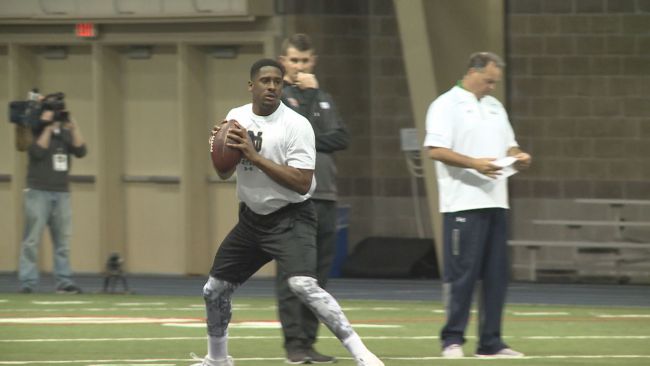
Everett Golson back at Notre Dame for pro day. Photo via wane.com
There have been a lot of discussions lately as to whether or not the graduate transfer rule is good for college football. As Notre Dame fans, we’ve seen this rule first hand with Everett Golson. Was Golson’s experience utilizing the graduate transfer rule an educational opportunity, or was it merely an athletic loophole? Let’s have a look!
Before we look at the nitty-gritty of Golson’s situation, let’s take a look at what the intent of the graduate transfer exception was when it was created. The graduate transfer rule was created with the purpose of providing educational opportunities for college athletes who have already earned a degree and want to pursue a graduate degree not offered by their current school.
Golson graduated from Notre Dame with a business administration degree from the Mendoza College of Business at Notre Dame in the spring of 2015. On his Florida State player bio it simply listed him as “graduate,” and did not specify what his graduate studies were in, but if the rule truly was being followed correctly, he was studying something that was not offered by Notre Dame.
Golson played two years at Notre Dame (2012 and 2014) after being red-shirted his freshman season (2011), and sitting out the 2013 season after becoming academically ineligible. In 2012 Golson completed 187 of 318 attempts, for 2,405 yards; a 58.8% completion rate. He averaged 7.56 yards per attempt, and had 12 touchdowns and 6 interceptions.
In 2014, after sitting out for a year, Golson completed 256 of 427 attempts, for 3,445 yards; a 60.0% completion rate.. He averaged 8.07 yards per attempt, and had 29 touchdowns and 14 interceptions. After a disastrous USC game in 2014 where Zaire was brought in, and then not starting in the Music City Bowl vs. LSU, Golson decided in the spring of 2015 to take advantage of the graduate transfer rule and transfer to Florida State University for his final year of eligibility.
In May of 2015 Golson commented, “It’s something that’s pretty crazy right now for me to adjust to, but I do think it was best for me. I just needed a fresh start. It was me sitting down and thinking, ‘OK, where do I feel the most comfortable?’ It was nothing to knock Notre Dame. I just had to put myself in the best position possible.”
Golson wasn’t promised by FSU coach Jimbo Fisher that the starting job would be his, but all the same Golson felt it was a better situation than the one he was in at Notre Dame. Did his gamble pay off? Well, it may be a bit too early to say for sure whether or not his gamble paid off, but here is what we know right now.
As a graduate transfer quarterback at FSU, Golson completed 147 of 219 attempts, for 1,778 yards; a 67.1% completion rate. He averaged 8.12 yards per attempt, and had 11 touchdowns and three interceptions. He ended up coming back to Notre Dame to participate in their NFL Pro Day scouting activities instead of doing them at FSU. Golson was not selected in the 2016 NFL draft, but was invited by the Indianapolis Colts and the Philadelphia Eagles to come in for tryouts. Neither franchise offered Golson a position. He is currently on the practice roster of the Hamilton Tiger-Cats in the Canadian Football League.
Would his current situation have been different had he stayed at Notre Dame? I’m not sure we’ll ever be able to truly answer that; but his situation leads me to wonder how many college football players who utilize the graduate transfer rule are actually using it for its intended purpose, or has it turned into a “free agency” of sorts for players looking for a better football situation. The following statement from Penn State coach James Franklin is being echoed by many of his peers, “I think the thing that’s probably concerning to administrators, commissioners and school presidents is: What are we doing? Are we truly offering another educational opportunity somewhere else or is this strictly a football decision?”
Some conferences are setting their own regulations to prevent these type of situations. In the Southeastern Conference, if a graduate transfer does not complete the graduate program, the player’s school cannot enroll another athlete under the exception for three years. Maybe if the NCAA made a similar adjustment to the exception, it would maintain the integrity of the rule and prevent its abuse.
What say you? Is the graduate transfer rule good or bad for college football?
Cheers & GO IRISH!

Her Loyal ... Daughter
Lisa Kelly is a multidimensional marketing professional. She has over two decades of marketing experience and earned a bachelor of business administration and marketing from the University of Notre Dame (Class of 1993 ... Siegfried Hall!). She is a Digital Publishing Manager by day and by night is writing her third book, a continuation of "Echoes From the End Zone: The Men We Became" and its sequel "The Men We Became: MORE Echoes From the End Zone." In 2012, Lisa was crowned the "Biggest Fan of the Big East" in a blogging and social media contest, representing Notre Dame.
Read all posts by Lisa
- Breaking Discoveries in CTE Research? - March 12, 2018
- A Football Player’s Lucky Charm? - February 22, 2018
- Part II: From Football to Coffee Beans? - January 31, 2018

I don’t like the rule. I also don’t like that Golson did his pro day at Notre Dame. Then again, it was probably better from a politically correct standpoint that they let him. I guess it would be seen as petty.