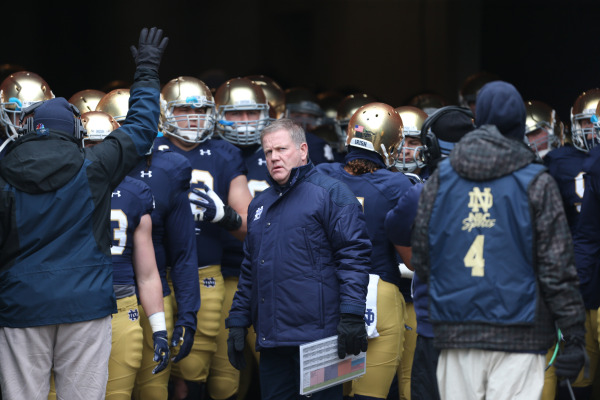
As many singers, crooners, and generalized creepers got done saying last month, “Baby, it’s cold outside.” It’s not just the temperature though. It’s also the inescapable knowledge that there are nearly nine months until the next Notre Dame football game. Hellooooooo super-fun-crazy-pick-at-the-scab-obsessive-dwelling-time. Yes, the calendar’s changed to 2015, and if you’re like Marty McFly and me, you’re anxiously awaiting the arrival of many a splendor. Jaws 19 is gonna be something to behold. The only thing I am sure of coming into this offseason is that many people can and will speculate on the future of Notre Dame’s offense. Rightfully, a significant portion of that debate will focus on the quarterback position, but not today.
How you want to answer the “who should be the quarterback” question might depend on how you view Brian Kelly. The question’s certainly more complex than just that, but it’s January 8th people, so plenty of time to dissect the respective pros and cons of Everett Golson and Malik Zaire. For today, the inquiry is about Brian Kelly and what to expect from his offense moving forward.
The change noticeable to many during the Music City Bowl versus LSU was the renewed (new?) emphasis on good ‘ole #RTDB (Run the Ball!!). Is the solution as simple as running the ball more? One frustration with the Kelly era has been the failure to match the offensive success he exhibited at his previous stops. Of course, the bar was set awfully high at the time Brian Kelly accepted the Notre Dame job. The 2009 Cincinnati team was Kelly’s best offense, period. So what should we expect? Put more basically: What is the “Brian Kelly Offense?” The chart below represents each season Brian Kelly’s been a head coach at the FBS level. Let me briefly explain the categories, present the chart, and then we can jump into the data like Golden Tate into the Michigan State band.
Year: Season year
School: School at which BK was coaching
Run %: Percentage of total offensive plays on which offense ran the ball
Pass Att.: Total pass attempts by team
Int.: Interceptions
Int %: Percentage of pass attempts resulting in an INT
PPG: Points Per Game (Combined, not offense specific)
PPP: Points per play run by the offense
PPP Rk: National rank out of 128 FBS teams
W: Wins
| Year | School | Run % | Pass Att. | Int. | Int. % | PPG | PPP | PPP Rk | W |
|---|---|---|---|---|---|---|---|---|---|
| 2004 | CMU | 52.45% | 374 | 10 | 2.67% | 21.6 | 0.279 | 92 | 4 |
| 2005 | CMU | 49.77% | 425 | 6 | 1.41% | 23.6 | 0.298 | 87 | 6 |
| 2006 | CMU | 47.10% | 446 | 11 | 2.47% | 29.7 | 0.464 | 16 | 9 |
| 2007 | Cincy | 48.81% | 462 | 12 | 2.60% | 34.4 | 0.469 | 17 | 10 |
| 2008 | Cincy | 47.14% | 471 | 15 | 3.18% | 24.8 | 0.368 | 55 | 11 |
| 2009 | Cincy | 41.43% | 470 | 8 | 1.70% | 36 | 0.561 | 2 | 12 |
| 2010 | ND | 44.61% | 481 | 16 | 3.33% | 26.3 | 0.38 | 60 | 8 |
| 2011 | ND | 46.91% | 473 | 17 | 3.59% | 29.2 | 0.412 | 37 | 8 |
| 2012 | ND | 56.96% | 388 | 8 | 2.06% | 25.8 | 0.375 | 67 | 12 |
| 2013 | ND | 50.17% | 429 | 13 | 3.03% | 27.2 | 0.404 | 48 | 9 |
| 2014 | ND | 49.64% | 463 | 14 | 3.02% | 32.8 | 0.438 | 31 | 8 |
Kelly spent exactly three years at each of Central Michigan and Cincinnati. At the end of the 2015 season, he will have been with Notre Dame for the same amount of time as he was combined at CMU and UC. I only mention this to say, the Notre Dame tenure should be weighed as much as all of his previous time when we talk about “what is Brian Kelly?”
Run Percentage:
There is no question that BK offenses on the whole are pass heavy. When he arrived in 2010, that was very much what people expected to see. After all, no BK team passed more and ran less in terms of play mix than the Cincinnati 2009 team (59% passing, 41% rushing). It was also Brian Kelly’s highest scoring team on a per game basis at 36 points per game. For these reasons his reputation coming into Notre Dame was as a high-scoring pass happy kind of guy.
Only once in Kelly’s eleven seasons has his team ranked in the top third of teams in rushing play percentage. The argument every RTDB enthusiast makes is that the one year ND ranked in top third was 2012. Only three times has Kelly had a rushing play percentage above 50%: 2004, 2012, and 2013. What may be the biggest oddity is that at both Central Michigan and Cincinnati, Kelly showed a pattern of upon arrival rushing more and then gradually passing more. His last season at both Central Michigan and Cincinnati represented his lowest proportion of rushing plays.
However, upon arrival at Notre Dame, Kelly actually started off passing more. 2010 and 2011 rank #2 and #3 for seasons with the lowest rushing percentage behind 2009. Despite what many perceived to be abandoning the rush in 2014, that’s not entirely true…at least by Brian Kelly standards.
Points Per Play:
I had a tweet sent to me by @IrishTightness passing along a tweet by @CFBMatrix which stated that 5 of the past 7 winners of the National Title Game have ranked in the Top 5 in Points Per Play in the same season. Looking at the 2014 leaders for Points Per Play, each of the top 9 teams went to and won their bowl game. That includes Oregon and Ohio State who will play for the National Title Game on January 12th.
Points Per Play is a descriptive stat. It gives a rough idea of both 1) How explosive an offense is, and 2) how efficient it is at turning plays/yards into points. It inherently also captures whether a team is turnover prone or not. A turnover prone team will see a reduction in efficiency because any drive that ends in a turnover results in a 0.00 for Points Per Play.
At both Central Michigan and Cincinnati Brian Kelly had at least one season in which his team finished in the top 20 in PPP. However, in his 5 seasons at ND, a Kelly offense has yet to crack the top 30. The 2014 offense was actually the best he’s done in PPP. Whatever Everett Golson’s faults were, and there were many, this season saw an ND team score its greatest points per game and was the most efficient version of the Kelly offense. Had Golson’s turnovers, and more specifically his fumbles been reduced, this offense had the potential to finish in the top 20.
2012 by contrast was the lowest scoring and least efficient offense of the Notre Dame years. Yes, the game control offense got ND to a national title game, but the numbers further bolster how important the defense was to that effort.
For Brian Kelly to be successful, it seems unlikely the 2012 formula is either what the fans should expect or what he does best. When considering Brian Kelly’s entire career, it’s a better practice to consider 2012 an outlier rather than a formula to success. PPP is a predictor of overall offensive efficiency, and being middle of the pack will never be a consistent way to win.
Interception Percentage:
Perhaps the most troubling trend since arriving at ND is not the play mix but the execution of the plays called. The single greatest reason Kelly’s offenses have failed to live up to their potential has been interceptions. In the six seasons prior to his Irish arrival, Kelly’s teams had just one season in which interception rate exceeded 2.75%.
Since arriving at Notre Dame, Kelly’s had just one season in which the team’s interception rate has been below 2.75%
It’s reasonable to believe that reducing the number of pass attempts and throwing safer passes might alleviate this problem. See: 2012. However, consider that in 2009, his Cincinnati team threw nearly 100 more passes and had the same number of interceptions. Kelly teams do not show a demonstrable pattern between pass attempts and interception rate. There has been a clear division between his previous stops and Notre Dame.
Thoughts Going Forward:
Brian Kelly’s teams have shown an ability to win as both an extreme pass team and a rush heavy team. When the Kelly passing attack operates at a high level, Kelly runs one of the most efficient offenses in the nation. The problem’s been the Notre Dame version of the Kelly offense has never been efficient.
Even the 2012 team so loved was not an efficient version of the Brian Kelly system. As I stated at the outset, the debate this offseason is going to revolve around the quarterback position. My hope is that we consider what quarterback fits Brian Kelly’s system the best. The system Kelly wants to run need not be the most pass heavy version he can roll out, but it does need to be more efficient and produce fewer turnovers to reach an elite, championship level.
Survivor of the Davie, O'Leary, Willingham football eras. Southern. Charming and more often than not the wittiest person at his dinner table (he eats alone quite a bit).
- Who the _______ am I Watching? ND’s Depth Chart (Literally) by the Numbers (Part II) - August 29, 2019
- Who the _______ am I Watching? ND’s Depth Chart (Literally) by the Numbers - August 27, 2019
- The People’s Free Guide to ND Football 2019 - August 26, 2019
Outstanding analysis and a great way to begin the offseason scab-picking (love that!) The pre-ND trends are clear, and even more so when read in the context of what Kelly has been preaching since he arrived at ND. Priority #1: establish a winning culture. That includes winning on individual Saturdays, but also building a program for the long haul. Priority #2, I’d argue: develop solid QB play to run “his offense.”
That plays out in the pre-ND data. Increasing pass pay %, increasing win totals at both schools.
It hasn’t happened at ND, but the common problem through Kelly’s tenure: not solid at QB. He loses Clausen before ’10, D. Crist was a debacle, T. Rees was limited in his skill set, and in ’12 he’s got Golson as the redshirt freshman. ’13 should have finally been the year to stablize, then Golson is suspended. That truly was a lost season, and doubly so when you consider the growing pains Golson could have gone through in ’13 instead of ’14.
’14 was also a question mark, with Golson back after a year of inactivity and in only his 2nd season of real playing time. That’s 5 years at ND without stability and reliability at the QB position, and I think it’s a huge factor in explaining the data you’ve put together.
Thanks!
Thanks for the kind words, and couldn’t agree more. At both previous stops, Kelly seemed to get above average QB play that accelerated his offense. At ND, it’s been anything anything but.
Something interesting: 2012 and 2014 are the best years for Int% at ND, confirming what was kind of obvious: Golson’s been the best of a bad lot. Can Golson no only regain his confidence but also improve on his decision making/play? The leash is quite short at this point (if it exists at all). Great comments. – Moons
I get that your conclusion is an anlysis of the QB position but why leave fumbles out of the stats? I agree completely with the analysis, though. Turnovers are a problem in creating an efficient offense. Turnovers were a big reason 2012 was a success the others, 2014 and 2011 in particular, were disappointments.
I’d like to see Golson play his final year at ND this fall but I think Kelly and the “noise” around the program, including the fans, have all gotten in his head. My concern over moving to Zaire at QB is it brings back the “we’re a year away” excuse again. 2015 should be a big year for ND with all the starters coming back. Letting an inexperienced QB run the team seems like a waste. But then it worked in 2012.
Good point on the fumbles. If I’m being honest, reliable fumbles lost data is difficult to find. I wouldn’t include it without good data for each year. I suppose I could have gone with TO, TO margin, etc….but I did want to draw attention to the notion that pass attempts/pass heavy or not is not the entire difference in the “Kelly offense” year over year.
Thanks for reading and the response.
You are right. Going by the Points per play number 2012 was the least efficient offense Kelly has had at ND. But 2014 was the most efficient. At previous stops higher PPP rankings usually correlated with more wins. That, like a lot of other factors, has been very different at ND. I guess the bottom line is what worked at Central Michigan and Cincinnati may not work at ND.
PREACH ON THE FUMBLE STATS.
I have no idea why this isn’t tracked like INTs. The hilarious part is that individual forced fumble stats are tracked, but not the guy that fumbled it. Maddening.
The reason we were ABLE to #RTDB was a quantum leap in offensive line play. Full stop.
It seems a pattern that great college quarterbacks at ND and elsewhere have historically shown flashes of brilliance (TDs, yards and clutch plays) along with heartbreaking errors (INTs and misreads) the season before they have their big breakout. Why should Golson, playing just his 2nd season of college football, have been any different? Without the heat (DB)- seeking tipped balls by receivers and at the line of scrimmage, he would have had several fewer interceptions. He has cleaned up the fumbles and the offensive line looks like it will finally protect him for running for his life. If history repeats itself, he should absolutely crush it next year, as long as he can rise above the noise and criticisms always thrown at a QB who is almost but not quite there this season. Next year, Golson, Kelly and company – with a healthy dose of Malik Zaire and read option wrinkle, and a better, older, more experienced team to surround the QB – could make history.
Don’t know if there are any metrics for this, but I’d like to see his run-pass ratios by quarter. It was always my perception that Kelly ran the ball almost exclusively to protect fourth quarter leads. If so, the final numbers wouldn’t really be an accurate representation of actual events.