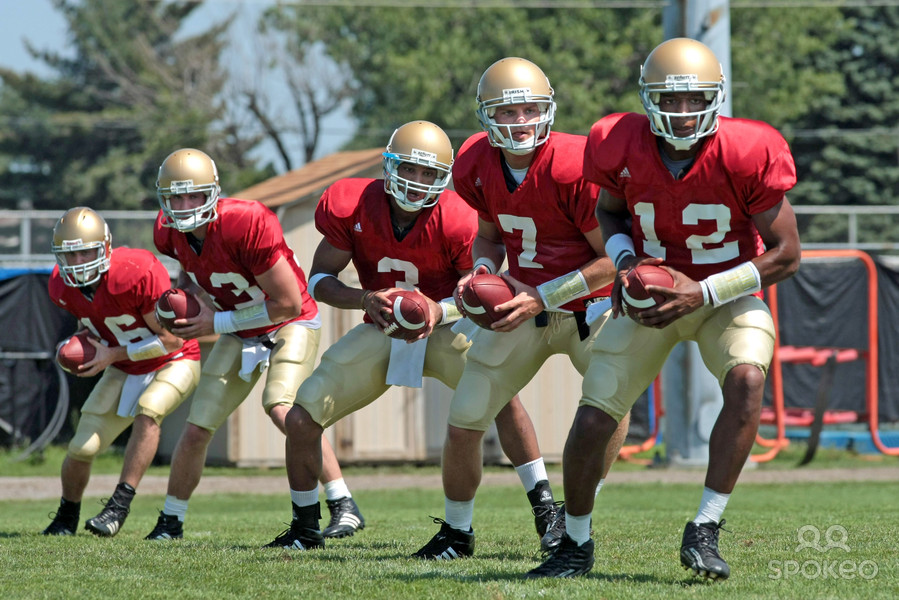
I admit I bristled when South Bend Tribune writer Mike Vorel tweeted this after Everett Golson announced he’d be transferring from Notre Dame:
Since the end of the Holtz Era, 18 #NotreDame QBs have either switched positions, transferred, or both. Add Golson: http://t.co/Mvi9XAgxv2
— Mike Vorel (@mikevorel) May 7, 2015
I don’t like stats that lack context, although I’m guilty of offering them up from time to time myself. This tweet prompted two questions: Is this something to be concerned about? And how does this compare to other Top 25 teams?
I’ve now done the homework myself. Since 1999, high school athletes recruited as quarterbacks have transferred from Notre Dame at a slightly more frequent rate than nine other schools – Alabama, Boise State, LSU, Michigan, Ohio St., Oklahoma, Oregon, Texas and USC. (Walk-ons, whether they were eventually given scholarships or not, were not counted. Those who have already enrolled – such as Alabama’s Blake Barnett – were counted, but those who have signed a letter of intent but have not yet enrolled – such as Notre Dame’s Brandon Wimbush – were not.)
The South Bend Tribune’s Eric Hansen, citing the stat he created and Vorel mentioned, said these 18 QBs represented a “staggering number of detoured dreams.” I disagree – and I’ll explain why in a moment.
First, let’s look at the numbers – again since 1999:
| Tracking QBs from Major Programs | Left early (NFL), Quit (injury/new sport), dismissed (no transfer) | |||||
| Team | # of QBs | Still QB on team | Graduated | Transferred | Position Switch | |
| Alabama | 19 | 3 | 4 | 8 | 1 | 3 |
| Oregon | 20 | 3 | 6 | 7 | 2 | 2 |
| ND | 20 | 2 | 3 | 9 | 5 | 1 |
| Oklahoma | 18 | 3 | 3 | 5 | 4 | 3 |
| Michigan | 18 | 3 | 5 | 7 | 1 | 2 |
| Boise St. | 17 | 4 | 7 | 4 | 1 | 1 |
| Texas | 17 | 2 | 6 | 6 | 1 | 2 |
| USC | 17 | 4 | 5 | 4 | 2 | 2 |
| LSU | 17 | 3 | 5 | 5 | 0 | 4 |
| Ohio St. | 16 | 3 | 7 | 5 | 0 | 1 |
For reference, here are the wins for each program since 1999: Boise State (165); Oklahoma (159); Ohio State (157); LSU (148); USC (146); Texas (145); Oregon (144); Alabama (135); Michigan (118); Notre Dame (115).
ARE THE NUMBER OF TRANSFERS, POSITION SWITCHES & EARLY EXITS SOMETHING TO BE CONCERNED ABOUT?
First: Let’s talk math.
If we compare program wins to # of transfers, the correlation is -0.82, which suggests that high number of transfers at the quarterback position equates to less program wins (and vice versa) – for at least these 10 programs. Then again, the coefficient of determination is 0.6864, which means that 68 percent of the total variation in wins can be explained by a linear relationship between quarterback transfers and team wins. The other 32 percent of the total variation remains unexplained.
Now: Back to English. 
In Notre Dame’s case, I’d argue the number of transfers, position switches and early exits aren’t something to be concerned about.
Let’s break it down, starting with the easiest category.
Notre Dame has 1 individual who either left the program early to join the NFL, quit because of injury or to pursue a different sport or was dismissed without landing at another school. That was Jimmy Clausen.
Clausen listed to the advice of the coach who recruited him, Charlie Weis, and declared for the draft with one year of college eligibility remaining. At the time, he was “perhaps the top quarterback in this year’s [2010] class,” according to ESPN.
I think it reflects well on Notre Dame’s program that they had a quarterback that was coveted by NFL teams, so this is no cause for concern from my perspective.
The Irish had five individuals who switched positions:
Courtesy of UND.com
Jared Clark, recruited in 2000, was stuck behind Carlyle Holiday and former walk-on Pat Dillingham on the depth chart when he switched to tight end in 2002. He played 47 game minutes in 2002 and 95 in 2003, ending up fifth on the team in receptions his senior year.
Holiday, also recruited in 2000, started at quarterback for most of 2001, all of 2002 and the beginning of 2003 until Brady Quinn emerged as the definitive signal caller. Holiday switched to wide receiver his senior year and, although undrafted, played four seasons in the NFL at wide receiver.
Abram Elam, also recruited in 2000, switched to safety in August of his freshman year. After a solid showing as a reserve safety, his Notre Dame career ended poorly. He was dismissed from the team after a felony sexual battery conviction. He’d eventually enroll in Kent State and ended up playing 7 years in the NFL, all at safety.
Darrin Bragg, recruited in 2004, was moved to wide receiver by new coach Charlie Weis in 2005. He quit the team after receiving no playing time at wide receiver over two seasons, but rejoined as the team’s third string quarterback in 2007.
Image courtesy of Wikipedia user Tedmoseby
The Irish never found the right spot for Luke Massa, who was recruited in 2010. He was moved from quarterback to tight end to receiver before settling in as the team’s holder for field goal attempts.
Since Elam and Holiday ended up in the NFL, I’d say their “detours” worked out in their favor, regardless of the circumstances. I don’t think fans should be concerned that it didn’t work out for them at quarterback.
The Irish took four quarterbacks in 2000 if you count Elam – which I did, but others don’t – so it was inevitable that someone was going to draw the short straw. Clark did not realize his potential at QB, but he still contributed to the offense. He also graduated from Notre Dame, which should not be discounted.
In all, I don’t believe it should concern Irish fans that five individuals recruited as quarterbacks switched positions – especially when Notre Dame recruited the most QBs (20) in the 15-year stretch I studied.
Now let’s discuss the nine who transferred:
Dayne Crist, Andrew Hendrix and Everett Golson took advantage of the graduate transfer rule and left after finishing their degree at Notre Dame.
Crist, who was recruited by Charlie Weis, joined his former coach in Kansas after being benched by Weis’ replacement, Brian Kelly.

Image courtesy of Flickr (via Michael Li)
Hendrix, who came in with Kelly’s first class, had NFL ambitions and knew he wouldn’t get snaps if he stayed at Notre Dame. So he transferred to Miami (Ohio), where he knew he’d be the No. 1 starter.
Golson transferred to Florida State, presumably to keep his own NFL ambitions alive.
The relationship between student-athlete and university is supposed to be mutually beneficial: The school gives the student-athlete the opportunity to earn a degree, while the student-athlete gives his benefactor his best four years on the field. If Crist and Hendrix had stayed, I’m not sure either would have seen the field during the 2012 and 2014 seasons, respectively. Their decision to transfer makes sense, and doesn’t seem to reflect poorly on Notre Dame.
That leaves six who left Notre Dame before graduating and sat out a year before playing at a different FBS school: Matt LoVecchio, Christian Olsen, David Wolke, Zach Frazer, Demetrius Jones and Gunner Kiel.
LoVecchio transferred to Indiana after barely playing in Bob Davie’s final disastrous year and with Tyrone Willingham unwilling to make him the starter in 2002.
Olsen admitted after transferring to Virginia, that he “really didn’t want to be at Notre Dame from [his] first semester on” and that “it just wasn’t a school that I fit in at.” That’s a bigger concern: That Notre Dame coaches didn’t correctly identify a player who wanted to be there.
Wolke, who left in the summer of 2006, was Brady Quinn’s backup for two seasons before losing that job to Evan Sharpley. With Zach Frazer and Demetrius Jones incoming, Wolke left for Western Kentucky – where, frankly, he had two very disappointing seasons for the Hilltoppers.
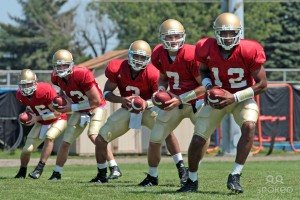
Image via Spokeo
Had Wolke stayed, he would not have had to contend with Frazer or Jones – because they both left too. Frazer was considered fourth best in a competition for the starting spot in 2007. Had he stayed, he would have most certainly played behind Clausen – but may have had a shot when Jimmy sustained injuries. Of course, Frazer levied his comeuppance on Charlie Weis by beating Clausen and the Irish in South Bend as a member of the UConn Huskies.
Jones won the starter’s job in 2007, only to transfer immediately after losing the job in the first game to Clausen. Jones, who ended his career playing tight end and wide receiver at a Division II school said his “only regret [was he] didn’t stay at Notre Dame,” adding, “If I had stayed and played multiple positions like I went on to do, I’d be playing on Sundays right now.”
Gunner Kiel transferred to Cincinnati because he “didn’t want to run the scout team anymore.” It makes sense to me.
LoVecchio, Wolke, Frazer and Kiel left for a better opportunity to start, while Olsen and Jones transferred after becoming disillusioned about their future in South Bend.
HOW DOES THIS COMPARE TO OTHER TOP 25 TEAMS?
Of the 10 schools surveyed, Notre Dame had the highest percentage of its recruited quarterbacks transfer to a different school. Michigan was second.
The Irish were second-to-last in the number of high school athletes who were recruited as quarterbacks, remained in the position and exhausted their eligibility. Just three – Brady Quinn, Evan Sharpley and Tommy Rees – out of 20 were in this category. Oklahoma was worst, with just 3 – Jason White, Joey Halzle & Landry Jones – out of 19 in this category.
However, I reject the notion that it’s appropriate to consider positions switches equal to transfers as part of an umbrella category. While those on Notre Dame that moved positions didn’t likely change the outcome of any single game, they still contributed to the team’s success. With transfers, there’s zero additional benefit.
If position switches are combined with graduations, Notre Dame looks a lot better in comparison to these nine outstanding teams. There are eight individuals recruited as quarterback who eventually graduated from Notre Dame with no eligibility remaining, tied for first with Oregon and Boise State.
If the goal is graduating student-athletes, then Notre Dame is doing just fine with their quarterback recruits.

Notre Dame graduate, class of '02 (the Davie years!). A former newspaper and TV reporter, andrewwinn is now professionally involved in something far less fun to discuss than college football. A dad, a husband and a wannabe data nerd.
Read all posts by andrewwinn
Follow @HLS_NDtex
- In Kelly-Harbaugh Recruit Fight, It’s Tied - January 19, 2017
- Catching Up With Matt Fortuna (Part 2) - January 6, 2017
- Catching Up With Matt Fortuna - January 5, 2017
